Bottle Decoration Mistakes That Only Show Up at Volume
Most decoration failures are approved before production starts. They pass because a one-off sample is judged on a bench, in good light, on a component that was handled by hand. The mistakes below are the ones that reliably survive that stage and only become visible once the run is moving: colour that drifts between two materials, print that distorts on a tapered shoulder, or an adhesive that lets go when the bottle meets a wet bathroom shelf. None of them are exotic. All of them are cheaper to prevent than to rework.
Key takeaways
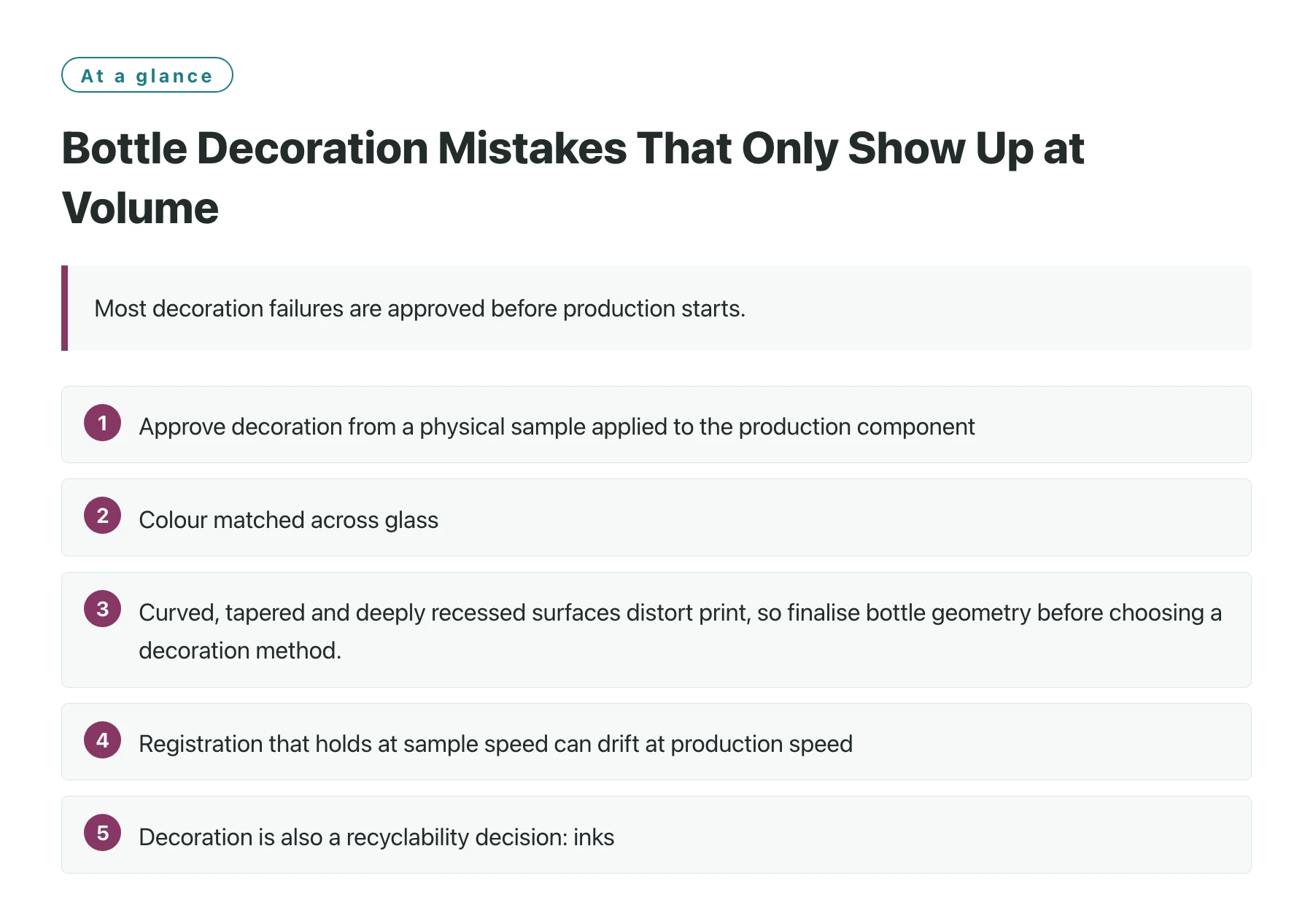
- Approve decoration from a physical sample applied to the production component, never from a screen render or a flat artwork proof.
- Colour matched across glass, aluminium and plastic will not look identical, because each substrate takes the same reference differently; approve each one separately.
- Curved, tapered and deeply recessed surfaces distort print, so finalise bottle geometry before choosing a decoration method.
- Registration that holds at sample speed can drift at production speed, which is why the approval sample should come off a running line.
- Decoration is also a recyclability decision: inks, foils and full-body coatings can work against the packaging rules your market is moving toward.
Decoration is the part of a fragrance project where brand and factory most often talk past each other. The brand is looking at a design. The factory is looking at a process window: what a screen can hold, what a foil will release, what a curved surface will do to a straight line.
The gap between those two views is where the expensive mistakes live. They rarely appear on a sample, because a sample is made slowly, inspected closely and forgiven generously.
What follows is the list worth walking through with whoever is going to decorate the bottle, in the order the decisions are actually made.
Mistakes made at the design stage
These are decisions that are cheap to change in a design file and expensive to change once tooling exists. They are also the ones most often settled by whoever answers email fastest.
A useful habit is to keep a single live artwork file with a revision number, and to require that any factory comment comes back against that revision. Decoration disputes are frequently version disputes in disguise.
That single-file habit is easier to keep when bottle design, decoration and filling sit inside one scope, because the design file and the production file become the same document. Manufacturers that publish bottle and packaging design alongside filling, as Guangzhou Xuelei does, are usually able to answer artwork questions against a live revision rather than a PDF that circulated last month.
Choosing the decoration method before the bottle is final
Screen printing on a flat panel is a different proposition from screen printing over a shoulder radius, and hot stamping behaves differently again on a matte versus a glossy surface. If the bottle geometry is still moving, so is the process. Fix the component, then choose the method.
Designing artwork for the wrong process
Hairlines, fine reversed type and tight gradients are the classic casualties. Each method has a resolution it holds comfortably and a point beyond which it becomes a reject generator. Ask the decorator what the minimum line weight and minimum type size are for the method under consideration, and design inside that window rather than testing it.
Forgetting that the design may need protection
A bottle shape and a decorative surface can be registrable as an industrial design, and registrations are only useful if the brand holds them rather than the supplier [1]. That is a design-stage decision with a decoration consequence: the more distinctive the surface treatment, the more it is worth protecting before it appears in a catalogue.
Mistakes made at the sampling stage
Sampling exists to catch problems while they are still cheap. It only works if the sample is representative, and a hand-made sample is representative only of the fact that the decoration can be produced at all.
Two habits make the difference: insist that the approval sample is applied to the production component, and insist that at least one sample comes from a running process rather than a bench.
Approving from a render
A screen render cannot show how ink sits on a curved surface, how a metallic foil catches light at an angle, or how a transparent coating yellows slightly over a clear glass wall. Approve a physical object, signed and dated, and hold one at each end.
Assuming colour will match across materials
The same reference colour lands differently on glass, anodised aluminium and moulded plastic, and the difference is visible when the components are assembled in the hand. Approve the cap, the collar, the bottle and the carton as an assembled set under the light source your customer will actually see them in, not under a single table lamp.
Skipping the tests that predict field failure
Two simple checks catch most early decoration failures: an adhesion check after abrasion, and exposure to the product itself plus a common alcohol-based hand sanitiser. A decoration that survives the laboratory but lifts after a month on a bathroom shelf was not tested under the conditions it will meet.
Decoration also has a waste consequence. Coatings, foils and multi-material assemblies reduce what can be recycled, and European packaging rules are moving steadily toward design-for-recycling and recycled-content obligations [2]. A decoration chosen without that in mind can become a market-access problem rather than a taste problem.
A decoration approval sequence that catches these early
- Freeze the componentFinal bottle, cap and pump signed off, with drawings and a physical reference held by both sides.
- Choose the method against the geometryWritten confirmation from the decorator of the process window: line weight, type size, position tolerance and the surfaces it cannot decorate.
- Test on the real componentDecoration applied to production parts, not to surrogate panels or generic bottles of a similar size.
- Approve an assembled setBottle, cap, collar and carton checked together for colour and finish, under a stated light source.
- Abrasion and product exposureAdhesion after rubbing, plus contact with the fragrance and a common alcohol-based product, recorded with the result.
- Take a running-line sampleAt least one sample pulled from a production-speed run so registration drift shows up before the bulk order does.
- Sign and retain the golden sampleOne sealed reference per party, labelled with date, batch and artwork revision number.
The single most useful line in a decoration specification is a number: the position tolerance in millimetres, the minimum type size, the colour reference and the light source it was checked under. Adjectives such as premium or elegant cannot be inspected, and a factory cannot be held to them.
Mistakes made after the order is placed
Late artwork changes are the most common avoidable cost in decoration, because plates and screens are made from a frozen file. Once they exist, a change to a logo position is not a design tweak, it is new tooling plus a re-approval cycle.
The second most common is treating the decoration line as separate from the filling line. A fully decorated bottle that then goes through filling, capping and cartoning is handled several more times, and each handling step is an opportunity to scuff a coating or chip a foil edge. It helps when the same operation controls both, because the sequence is designed once rather than negotiated between two vendors. That is the practical argument for keeping from formula to finished bottle under one plan, and for asking how a fragrance manufacturing under one roof arrangement sequences decoration against filling.
A manufacturer working from a fixed process plan will normally be able to answer that in a short paragraph. If the answer is a tour of the building instead, the sequence probably is not written down yet.
Sources
- WIPO — World Intellectual Property Organization —— The UN agency for intellectual property; resources on industrial design and patent protection relevant to product and packaging design.
- European Commission: Packaging Waste and the PPWR —— EU rules on packaging and packaging waste, including the Packaging and Packaging Waste Regulation requirements on recyclability and design.
Frequently asked questions
Why did my decoration sample look perfect but the production run did not?
Because the sample was almost certainly made slowly, by hand, and inspected under good light. Registration, ink laydown and colour drift with line speed, so at least one approval sample should come off a production-speed run.
Which decoration method holds the finest detail?
It depends on the substrate and the artwork. As a rule, methods that transfer an image from a prepared plate or screen hold finer detail than those that spray or coat a surface, but every method has a minimum line weight and type size that the decorator should state in writing.
Can I decorate the bottle after filling instead of before?
Sometimes, but it changes the handling risk and often the equipment route. Decoration before filling is usually preferred for full-body treatments, while some labelling and coding steps happen after. Settle the sequence with the party that controls both lines.
How do we stop colour mismatches between the cap and the bottle?
Approve them as an assembled set, on the actual materials, under a stated light source. The same reference will read differently on glass, metal and plastic, so each substrate needs its own approved sample.
Does decoration affect whether packaging can be recycled?
It can. Inks, metallic foils, full-body coatings and mixed-material assemblies all make recovery harder, and European packaging rules are moving toward design-for-recycling and recycled-content requirements, so it is worth choosing decoration with the destination market in mind.