A Practical Guide to Comparing factory-direct and trading-company offers
A factory-direct offer and a trading-company offer may differ in more than price. They can allocate product coordination, subcontractor management, quality checks, export handling, communication, and issue resolution to different parties. Buyers should verify each company’s actual role and compare the full scope of responsibility before deciding which arrangement best fits their team.
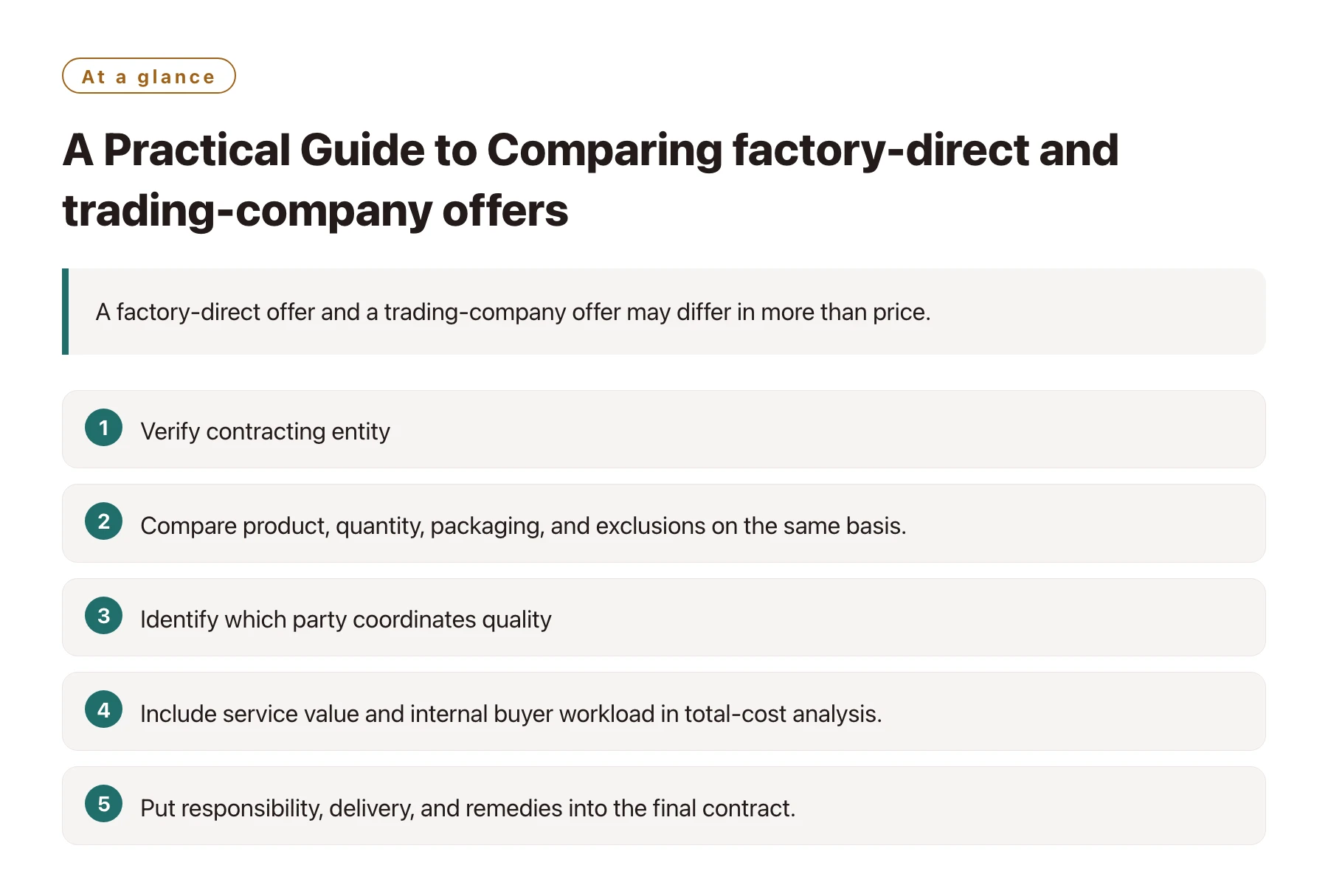
Key takeaways
- Verify contracting entity, production site, seller role, and payment beneficiary.
- Compare product, quantity, packaging, and exclusions on the same basis.
- Identify which party coordinates quality, subcontractors, documents, and logistics.
- Include service value and internal buyer workload in total-cost analysis.
- Put responsibility, delivery, and remedies into the final contract.
The useful comparison is between accountable delivery models, not between labels such as factory and trader.
1. Verify what each party actually does
For each offer, identify the legal seller, invoice issuer, payment beneficiary, manufacturer, export entity, and any sourcing or service provider. Ask which organization negotiates specifications, manages production, controls subcontractors, inspects goods, arranges shipping, and handles warranty claims.
A trading company may add coordination or combine products from multiple factories; a factory-direct seller may still rely on outside processors and export agents. Verify functions and authority rather than assuming a title describes the whole supply chain.
2. Align the product and commercial scope
Issue one product specification, quantity schedule, packaging requirement, destination, and quality criteria to both parties. Compare models, revisions, materials, customization, accessories, labels, tooling, minimum orders, price breaks, and sample fees. Record every alternative and missing item.
Check whether the trading-company offer includes a bundled package or whether its factory quote covers only production. Normalize units, currency, quote validity, and payment assumptions. Keep the original offers and written clarifications linked to the comparison version.
3. Compare price with service work included
A direct factory quote may show production price clearly but leave supplier coordination, independent quality oversight, document follow-up, and consolidation to the buyer. A trading-company price may include some of those services or embed margin. Ask for a transparent breakdown and service description.
Estimate the buyer’s internal cost of supplier search, translation, follow-up, inspection booking, issue handling, and coordination across factories. Include fees, travel, testing, freight, and pass-through costs. Compare the expected workload and service output, not only quoted product price.
4. Assess factory visibility and capability
Ask both offerors to identify the actual production site, key processes, equipment, capacity, and subcontractors. Determine whether the trader permits direct factory communication or visits and how it monitors its production partners. For direct purchasing, confirm the factory can support the order and export arrangement.
Review evidence for comparable products, process steps, records, and delivery performance. A trader’s supplier network can be useful only if factories are disclosed enough for the buyer’s risk and documentation needs. A factory’s own claims should still be supported by product-specific evidence.
5. Assign quality and corrective-action responsibility
Compare incoming material checks, production monitoring, final inspection, laboratory coordination, lot traceability, shipment release, and defect remedy. Identify who pays for independent inspection and who owns the technical acceptance decision. Ask for report examples and corrective-action workflow.
Ensure the responsible organization can access the factory and records when a problem occurs. Define containment, rework, replacement, reinspection, and escalation terms. A service provider can coordinate evidence, but the buyer should specify who is authorized to accept deviations.
6. Review communication and change control
Determine who receives technical questions, who answers them, and how the factory learns approved changes. Compare response times, language support, named account contacts, backup staff, and status reporting. For multi-factory orders, understand who resolves conflicting schedules or specifications.
Require controlled revisions for drawings, materials, site, subcontractor, labels, or production process. Keep direct instructions to the factory consistent with the seller’s contract role. Informal messages should not silently change the purchase order or approval baseline.
7. Compare capacity, lead time, and continuity
Request production milestones, material lead times, current order load, bottleneck operations, and available capacity. Ask whether an intermediary has reserved a slot or whether a factory has confirmed the order. Identify which party monitors dates and communicates slippage.
Assess continuity if the factory cannot perform, the trading company changes its supplier, or a key component is unavailable. Determine whether tooling, samples, production records, and quality history can move to another site. Compare realistic contingency options and their qualification lead time.
8. Clarify delivery, export, and handoff scope
Confirm who books transport, prepares export documents, arranges insurance, handles consolidation, pays origin charges, and coordinates destination delivery. Specify the delivery term, version, and named place if the contract uses Incoterms®. The ICC rules allocate certain tasks, costs, and risks when incorporated, but the service quote still needs detailed inclusions. [1]
Compare the same route, cargo data, handling, and receiving point. Identify whose name appears on commercial and shipping documents, who resolves discrepancies, and what delivery evidence the buyer receives.
9. Review contract, payment, and remedies
Check contracting authority, payment beneficiary, deposits, balance triggers, currency, warranty, defects, late delivery, cancellation, tooling, confidentiality, intellectual property, and dispute process. Verify any third-party account or affiliate arrangement before funds are sent.
State which party is responsible for supplier conduct, outsourced work, product conformity, documentation, and remedies. Where a trading company resells goods, ensure the contract does not leave the buyer without clear recourse. Seek qualified advice on material legal or tax questions.
10. Choose the model that fits buyer capability
Use a matrix for transparency, factory access, service scope, technical expertise, quality control, internal workload, total cost, capacity, continuity, delivery, and contract remedies. Screen mandatory requirements first; then weigh convenience and price. Record why the selected model fits current product and team needs.
Buyers comparing offers with Shanghai JS Sourcing should pilot the chosen arrangement, review actual communication and records, and reconcile total cost after delivery. Reassess if product mix, supplier network, volume, market, or internal procurement capability changes.
Sources
Frequently asked questions
Is a trading company always more expensive?
Not necessarily. Compare embedded services, supplier access, internal workload, and total delivered cost.
Does buying directly remove subcontractors?
No. Verify every critical process and component source regardless of the contracting model.
Who should own product acceptance?
Name the buyer-side technical or quality authority and document any delegated decision rights.
What should be compared besides unit price?
Compare service scope, quality responsibility, factory evidence, delivery, payment, remedies, and buyer effort.