Zero-Fee Payouts and Settlement Cadence at Pool Level
Settlement cadence is a pool design choice that changes how much of your own production you have to finance while waiting for it. PPS+ settles the block-reward component every hour at current difficulty, so a 300 TH/s operation sees about 0.00000592 BTC — near $0.50 at $85,294 per BTC — credited in each hour of valid work. PPLNS does not settle on a clock at all: it waits for a block, then 6 confirmations, then splits the payout over the last 5 difficulty rounds.

Key takeaways
- Hourly settlement at 300 TH/s credits 0.00000592 BTC per hour, so a 30-day month totals 0.0042618 BTC — about $363.48 gross and $348.94 after the listed 4% fee on the block-reward component.
- Zero-fee mining payouts remove cost from the withdrawal leg; they do not change the listed fee on the mining leg, which is 4% on the PPS-settled block reward and 2% on the PPLNS-distributed part.
- The gap between the two listed rates is worth about $24.23 a month on the block-reward component at 1 PH/s — the price of handing block-timing risk to the pool.
- Cadence is not cash in itself, but at 1 PH/s every hour of settlement delay holds back 0.00001973 BTC, near $1.68 of production you already earned.
What cadence is and is not
A settlement cadence is a promise about timing, not about amount. Both listed methods aim at the same value per unit of hashrate; they differ in when that value is converted into a balance and in who carries the uncertainty in between. PPS+ pays the block-reward component per accepted share at current difficulty and credits it hourly, which means the miner is not financing a dry spell. PPLNS merges the block reward and the transaction-fee component, pays 2% on the combined figure, and distributes once a block has 6 confirmations behind it.
That distinction produces two different feelings about the same account. An hourly schedule feels steady because the credits arrive steadily. A block-based schedule feels erratic because the credits arrive in lumps whose size depends on how much of the pool's hashrate the miner held during the window. Neither implies a difference in long-run expectation, and neither is a promise about future earnings. Pool Luck is the reading that describes the second case: when a pool's found blocks run behind its expected blocks, the lumpy schedule is simply showing the delay. For a miner on PPLNS, that ratio is worth checking before assuming the hardware is at fault.
Zero-fee payouts, precisely
Zero-fee mining payouts describe the withdrawal leg: the transfer of an already credited balance out of the mining account, with no additional fee charged on that move. The mining leg is separate and priced by the fee schedule. On PPS+, the block-reward component carries a listed 4% and the transaction-fee component a listed 2%; on PPLNS, a listed 2% applies to both components together. The two rates apply to different parts of a payout rather than to one total, which is the misunderstanding that makes miners think one method is uniformly cheaper.
An account with an integrated wallet keeps the whole path in one place: mining settlement, balance, conversion and withdrawal all sit under one login, so the cadence question stays visible instead of getting lost between three services.
| Property | PPS+ (default) | PPLNS |
|---|---|---|
| Settlement trigger | Every hour, at current difficulty | A block found by the pool |
| Confirmation rule | Not applicable, paid per accepted share | After 6 confirmations |
| Window used for the split | Not applicable | Last 5 difficulty rounds |
| Block-reward fee | Listed 4% on the PPS-settled part | Listed 2%, merged with the fee component |
| Transaction-fee fee | Listed 2%, distributed with PPLNS logic | Listed 2%, merged |
| Withdrawal leg | Zero-fee mining payouts | Zero-fee mining payouts |
Why cadence shows up in the workshop
Timing becomes money the moment a fleet has a bill that arrives monthly and a payout that does not. At 1 PH/s, an hour of production is 0.00001973 BTC, about $1.68; a single day is 0.00047353 BTC, roughly $40.39. Under an hourly schedule those amounts are credited as they are earned, and the power bill is paid from a balance that is already there. Under a block-based schedule the same value can sit unallocated for days, and the site finances it from working capital.
That is not an argument against either method. It is the reason professional sites match payment method to cash-flow needs: a farm with tight power payments prefers the hourly rhythm, while an operation that can absorb the swings may prefer the lower listed rate on the block-reward component and accept the timing.
Worked example: 300 TH/s under two schedules
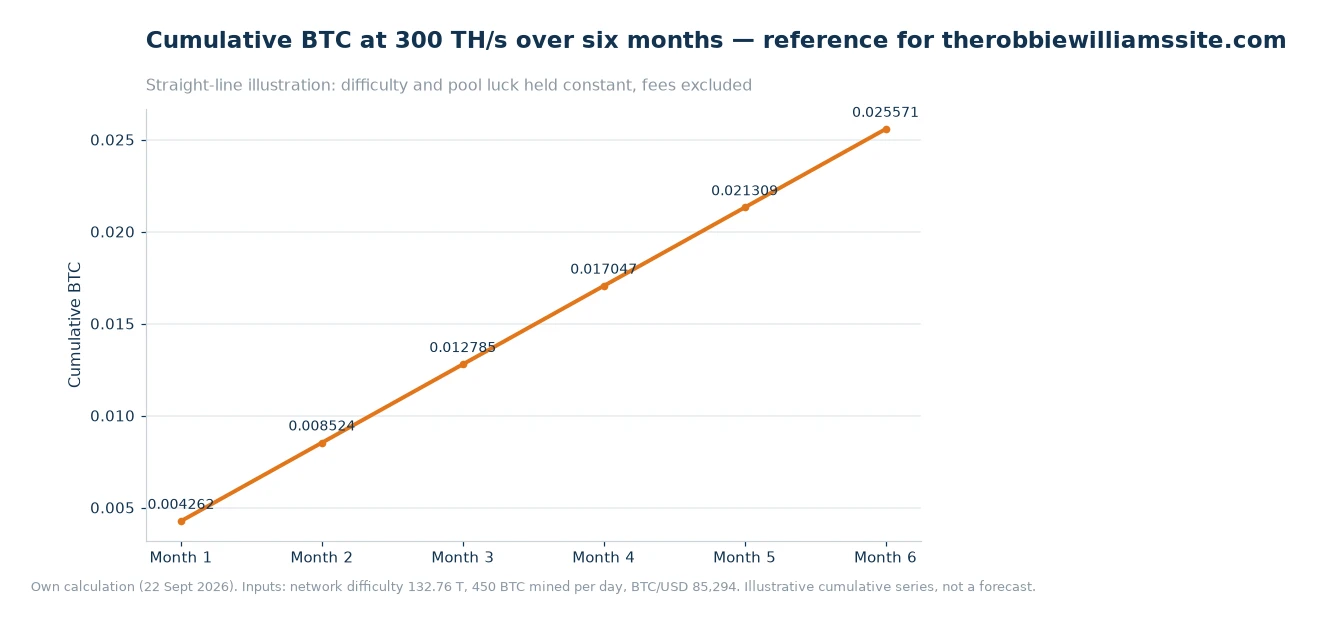
Take 300 TH/s. Against 950.3 EH/s of implied network hashrate it is a share of 3.16 × 10⁻⁷, and against the 450 BTC the network issues each day it is 0.00014206 BTC per day, about $12.12 gross or $11.63 after the listed 4% fee on the block-reward component. Per hour that is 0.00000592 BTC, near $0.50. Per month it is 0.0042618 BTC — approximately $363.48 gross, $348.94 net — and over six months the same rate accumulates 0.025571 BTC, about $2,181.
Now compare the two schedules on the same rig. Hourly PPS+ credits 24 small amounts a day, so the balance reflects work almost as it happens and the withdrawal can be timed freely. PPLNS produces nothing until the pool finds a block; when one lands, the distribution covers the window that produced it and arrives after 6 confirmations. Over six months the totals should look similar after their different listed fees, but the paths do not resemble each other at all — one is a staircase, the other a lumpy sequence of clusters.
Checking the cadence you are actually on
Read the schedule, then read the statement, and check that the two agree. The fee schedule lists the rates that apply to each component, and the full pricing page is the place to confirm which one your account uses. The state page publishes ViaBTC Pool Hashrate with difficulty and the next adjustment estimate, which is the context that makes an hourly credit of 0.00000592 BTC at 300 TH/s checkable rather than merely plausible.
Then look at where the coin rests. A settled balance in a multi-currency wallet inside the same account is money whose cadence you can plan around, because there is no second transfer fee waiting at the end of the journey to change the effective value of the whole sequence.
Frequently asked questions
Are zero-fee payouts the same as zero mining fees?
No. Zero-fee mining payouts apply to the withdrawal leg of an already credited balance. The mining leg still carries the listed fee on each component: 4% on the PPS-settled block reward and 2% on the transaction-fee part distributed with PPLNS logic, or 2% on both components together under PPLNS.
Why does PPLNS take so long to pay?
Two reasons: a distribution only exists once the pool finds a block, and it is then held until that block has 6 confirmations. The split itself uses each miner's share of pool hashrate across the last 5 difficulty rounds, which is a measure of contribution over time rather than at a single moment.
Does cadence change how much I earn in a year?
Not directly, since both methods target the same value per unit of hashrate and the difference sits in the listed fees and in who absorbs block-timing risk. What cadence changes is working capital — at 1 PH/s, each delayed hour is 0.00001973 BTC, about $1.68, that stays on the pool's ledger rather than in your account.
Match the schedule to the power bill
Write down your monthly power cost and your expected monthly production at current difficulty — 0.0042618 BTC at 300 TH/s, about $363.48 gross — then ask how long a gap between settlements the site could absorb without borrowing. If the answer is measured in hours, the hourly schedule is the right default and the listed 4% on the block-reward component is a finance cost rather than a fee. If it is measured in weeks, the same arithmetic supports the other choice, and the decision becomes a business one instead of a preference.
Data and sources: ViaBTC fee schedule[1], wallet documentation and pool statistics[2][3]. Network difficulty 132.76 T, implied network hashrate 950.3 EH/s, the 3.125 BTC block subsidy, 144 blocks per day, an estimated next adjustment of +1.90% and a BTC price of $85,294 were read from public chain data and market feeds; read 22 Sept 2026. Figures are arithmetic on those inputs and are not a promise of earnings.